


“Each time a woman stands up for herself, without knowing it possibly, without claiming it, she stands up for all women.” (Maya Angelou)
Imagine unpacking the holiday groceries when another threatening message arrives from your ex. Aunty Cheryl and the kids are arriving tomorrow so you might feel like you should keep quiet rather than disrupt the holiday. But we need to stop confusing keeping the festive peace with doing the right thing. Asking for a protection order doesn’t mean you’ve failed at family life. It means asking the law to enforce boundaries that someone else simply won’t respect.
The good news is you don’t have to hire an attorney (but of course we’re standing by to help) before asking a magistrate’s court for protection from domestic violence. The Constitutional Court has recognised the importance of an effective response to domestic violence. And that responsibility continues through the holidays when support services warn of heightened risks.
EMERGENCY AND SUPPORT INFORMATION
Immediate danger: call SAPS on 10111. Don’t wait for a protection order before seeking emergency assistance.
GBV Command Centre: 0800 428 428 for social-worker support and referrals, including help accessing shelter services. If you can’t get through and danger’s immediate, call SAPS.
Domestic violence isn’t only physical
The Domestic Violence Act recognises more than bruises. Threats, stalking, economic deprivation, emotional abuse, coercive behaviour, and controlling behaviour can all qualify. So can spiritual abuse and intentionally exposing children to domestic violence.
But context matters: an unpleasant disagreement isn’t automatically domestic violence. You don’t, however, have to accumulate incidents like loyalty points before asking for protection. Once is too often.
Who can apply for a protection order?
The Act covers qualifying domestic relationships, including spouses, former partners, dating relationships, family relationships and certain close relationships involving a shared home. Protection isn’t reserved for married people. A child may also apply without an adult’s assistance.
Someone with a material interest in your well-being, or a functionary acting in an official capacity, may apply on your behalf. Written consent is required however, except where the court considers the application in a child’s best interests or finds the complainant unable to consent. A child, or someone applying for a child, doesn’t need a parent’s or guardian’s consent or assistance. Where no domestic relationship exists, ask the court clerk whether the conduct qualifies under the Protection from Harassment Act.
Where to apply, including during the holidays
Approach a magistrate’s court in the area where you or the respondent permanently or temporarily live, study, carry on business or work, or where the conduct giving rise to the application occurred. There’s no minimum residence period, so temporary accommodation after leaving abuse can establish jurisdiction. Don’t return to the lion’s den to report the abuse.
You don’t need an attorney to apply. Ask the clerk for assistance filling in Form 6. An application can be considered outside ordinary hours or on a non-court day if the court’s satisfied you are in imminent danger. Explain that urgency. If the court is closed, approach your nearest police station for help accessing urgent after-hours assistance. Check routine opening hours directly with the court.
Protection-order application: Your practical checklist
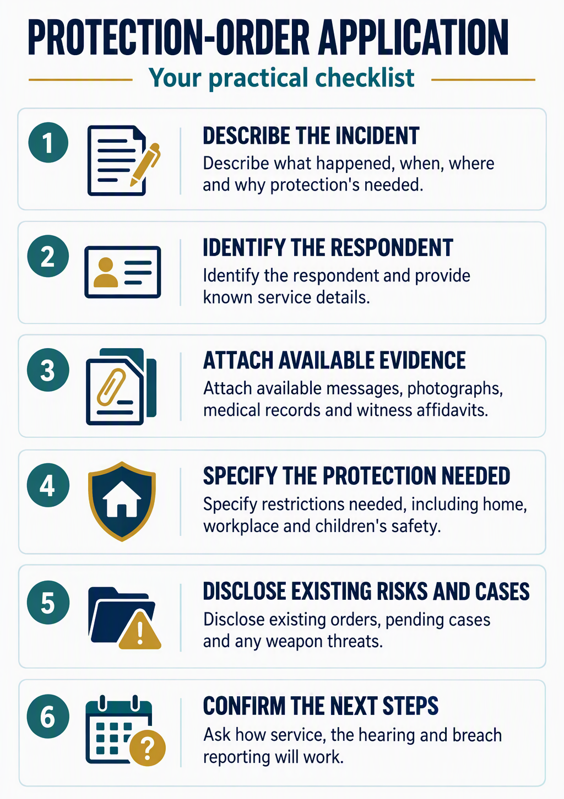
Your sworn account is evidence too. Supporting documents help, but don’t delay an urgent application while trying to assemble a perfect file. Preserve what’s safely available. Don’t put yourself at risk to collect more information. Ask the clerk about keeping your address confidential – make sure the separate personal-information “Form 6A” isn’t served on the respondent.
How interim and final protection orders work
- The court must issue an interim order, even without notifying the respondent first, if the evidence initially establishes domestic violence and resulting actual or possible harm, and the court is satisfied that immediate protection’s necessary.
- If no interim order is issued, the court must direct that the respondent receive notice to explain why a protection order shouldn’t be granted.
- An interim order takes effect once served: do not put yourself at risk by serving it yourself. Make sure you attend the return date (the date set for the court to consider the application again). If the respondent opposes the application, the court hears evidence and decides whether the required facts are more likely than not.
- When granting an interim or final protection order, Section 8(1) of the Act states that the court must also authorise a warrant for the respondent’s arrest. Its execution is suspended while the respondent complies with the order.
- A properly served respondent can’t defeat proceedings simply by staying away.
What a protection order can stop
Depending on the facts, orders can prohibit abuse, using others to commit abuse, and entry into your home, workplace, or place of study. Excluding the respondent from a shared home requires the court to consider your best interests. Contact with children may be refused or made subject to conditions in their best interests. Emergency monetary relief depends on both parties’ financial needs and resources. It will be up to you to explain precisely what protection you need.
What about guns?
It’s important that you tell the court and police about firearms or other dangerous weapons. Section 9 of The Domestic Violence Act provides for seizure in prescribed circumstances. In this regard, The Firearms Control Act also matters. But a protection application doesn’t automatically cancel a firearm licence.
What to do if a protection order is breached
Report a breach to SAPS with your order, the suspended warrant of arrest and an affidavit describing the contravention. On receiving the warrant and affidavit, police must then arrest the respondent if there are reasonable grounds to suspect that you are suffering or may suffer harm because of the alleged breach. If grounds for arrest are insufficient, police must immediately give the respondent a written notice to appear in court. Arrest isn’t automatic for every allegation.
Keep copies safely accessible and seek practical safety support alongside legal protection as paper can’t physically shield anyone. You can also report underlying crimes.
Getting legal help before the holidays
If this feels familiar, you don’t need to solve everything before asking for help. Speak confidentially to us, a court clerk or support service about your next safe step.
If someone’s trusted you with their story, offer practical help rather than an interrogation. They don’t owe anyone a polished account before being helped.
Disclaimer: The information provided herein should not be used or relied on as professional advice. No liability can be accepted for any errors or omissions nor for any loss or damage arising from reliance upon any information herein. Always contact us for specific and detailed advice.
© LawDotNews