


An important notice to clients
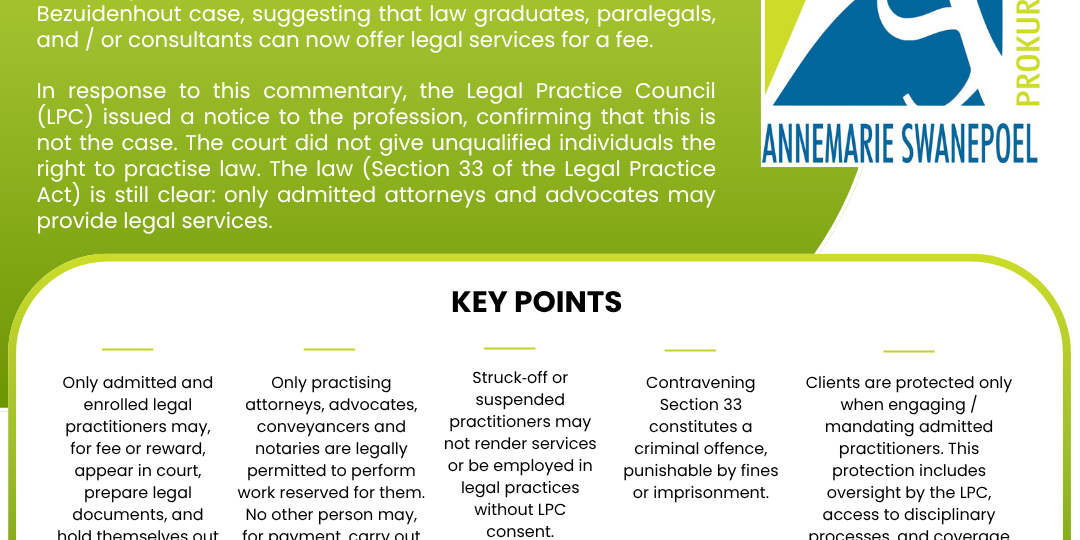
You may have seen comments online about the Damons Bezuidenhout case suggesting that law graduates, paralegals and consultants can now offer legal services for a fee.
That is not what the judgment did.
In response to the commentary, the Legal Practice Council issued a notice to the profession confirming the position. The court did not give unqualified individuals the right to practise law. Section 33 of the Legal Practice Act remains clear. Only admitted attorneys and advocates may provide legal services.
What the law actually says
Five points matter here, and they have not changed.
- Only admitted and enrolled legal practitioners may, for fee or reward, appear in court, prepare legal documents and hold themselves out as legal practitioners.
- Only practising attorneys, advocates, conveyancers and notaries are legally permitted to perform the work reserved for them. No other person may carry out those services for payment.
- Practitioners who have been struck off or suspended may not render legal services, and may not be employed in a legal practice without the consent of the Legal Practice Council.
- Contravening Section 33 is a criminal offence. It carries a fine or imprisonment.
- Clients are protected only when they engage or mandate an admitted practitioner.
Why this protection matters to you
When you instruct an admitted attorney, three things sit behind that relationship.
Oversight by the Legal Practice Council. Your attorney answers to a regulator.
Access to disciplinary processes. If something goes wrong, there is a formal route to raise it.
Coverage by the Legal Practitioners Fidelity Fund. Your money held in trust is protected.
None of that applies when you pay someone who is not admitted. If the work is wrong, the funds go missing or the matter is mishandled, you have no regulator to approach and no fund to claim from. You are left with a civil claim against a person who may have nothing.
How to check before you instruct anyone
Before you hand over a mandate or a cent, verify that the person rendering legal services to you is a practising legal practitioner enrolled with the Legal Practice Council. Contact your nearest LPC Provincial Office and ask.
The same office is where you lodge a complaint, or report unauthorised practice if you suspect someone is offering legal services without being admitted.
Know your attorney
A legal matter is usually something that already went wrong. The last thing you need is a second problem created by the person you asked to fix the first one. Ask the question early. A practising attorney will have no difficulty answering it.
If you are unsure about who is handling your matter, or you would like to discuss a legal issue with an admitted attorney, contact Annemarie Swanepoel Attorneys.